Videos
-
 The Future of AI and Technology | Olaf J. Groth, PhD
 -
Olaf Groth | AI and the Global Economy
-
Techno-Confucianism: Is a New Cold War Happening? - Olaf Groth | Endgame #210 (Luminaries)
-
Dr Olaf Groth - Keynote on the Cognitive Era at the AI Summit 2021 in Hamburg
-
UC Berkeley professor discusses threat of artificial intelligence in elections
-
UC Berkeley professor on Silicon Valley's influence in potential Harris-Trump matchup
-
Human Values and Power in a World of Artificial Intelligence | Olaf Groth | TEDxHultAshridge
-
Olaf Groth and Bhaskar Chakravorti on "The Great Remobilization"
-
Dr. Olaf Groth, Solomon’s Code: Humanity in a World of Thinking Machines, Samsung Forum
-
The Great Remobilization (w/ Olaf Groth, author)
-
Balancing Personalization with Data Privacy: Olaf Groth, Cambrian.ai | Genpact
-
Ep 71 | Dangers of AI- Dr. Olaf Groth on AI, Hype around Nvidia, Future of jobs & More






Learn More About Olaf Groth
As paradigm-shifting technologies – such as China’s DeepSeek – explode onto the scene, how do leaders know where to focus their attention while avoiding the traps that come with using new technologies?
With a well-honed ability to see beyond the horizon and around corners, futurist and technology strategist Olaf Groth, Ph.D., shows leaders how to harness the transformative power that emerging technologies will have on worldwide economies and businesses.
A professor of practice for global foresight, strategy, innovation and policy at UC Berkeley Haas School of Business, he has over three decades of experience advising governments like those of the US, Germany, Malaysia, the UAE and Kosovo, and multinationals including VW, Siemens, Karcher, Chevron, GE, Vodafone and Ferrari. Groth’s innovative frameworks guide companies through digital and geopolitical shifts while fostering responsible and strategic growth.
“Emerging and cognitive technology are coming up strong, and there’s an explosion of opportunity to shape the future – if we mitigate the risks,” explains Groth, who is also an adjunct professor at Hult IBS and honorary adjunct professor on UT Malaysia’s AI faculty. “But we won’t get to opportunity if we don’t address risk in parallel.”
At the intersection of strategy and futurism, Groth is a highly regarded corporate and government advisor who teaches globalization, business and technology courses at Haas. The founding CEO of AI and emerging technology analyst firm Cambrian Futures, and of the solution development studio Cambrian Labs, he and his team live on the cutting edge of technology’s future. As exemplified by their patents, “GeoTech” capabilities, and digital governance and data market frameworks, their true quest is to understand what lies beyond the horizon for businesses in the age of AI.
Groth’s ability to connect the dots between the engineering and business sides of emerging technology enables him to help leaders identify where the power shifts lie and utilize his frameworks to execute a strategy. Having built emerging technology and digital strategies, capabilities, programs and ventures, Groth is an expert at linking new technology to other ongoing social, political, and environmental changes and shifts. With a global view of business and tech – his work has taken him across more than 35 countries in North America, Europe, the Middle East, Africa and Asia – he eloquently illuminates the disruptive changes in the global economy in the context of emerging technologies.
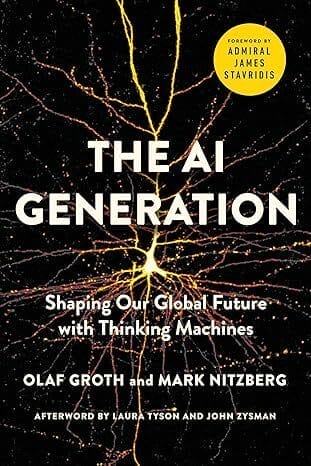
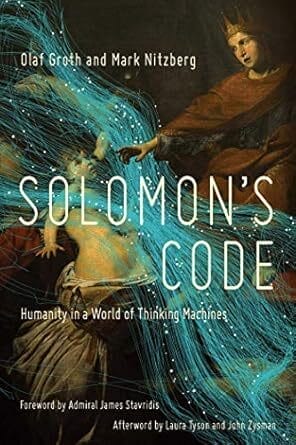
A prolific writer on the applications of emerging technologies, Groth is lead co-author of the award-winning book on the cognitive economy – a category that encompasses AI, brain-computer interfaces, and quantum computing – “The Great Remobilization: Strategies and Designs for a Smarter Future” (The MIT Press, October 2023), as well as “The A.I. Generation: Shaping Our Global Future with Thinking Machines”(Pegasus Books, August 2021) and its hardcover sibling “Solomon’s Code: Humanity in a World of Thinking Machines (Pegasus Books, November 2018).
“Right now, our excitement about AI is so high that developers are willing to cut corners without doing the proper testing,” explains Groth, who serves on the AI Task Force at Haas and frequently appears on panels such as AI and the transformation of work, manufacturing or the space economy. “The era of AI means we have unprecedented opportunity to make people’s lives richer, safer and more rewarding, but we can also do the opposite if we don’t design for it.”
An advisory council member of Kazakhstan’s Council for the Development of Artificial Intelligence, Groth is a big picture thinker who has lived in executive shoes himself. He provokes leaders to see their situation differently and helps companies transform in the midst of unpredictable technology and geopolitical landscapes.
GeoTech: Where Geopolitics Meets Emerging Technology
As international relations becomes a foreground issue for executives, “many companies that never considered geopolitics a core concern will find it inescapable now,” writes Groth for the World Economic Forum.
“GeoTech, or tech at the center of geopolitics, is everywhere. So how do we sort through that? What are the horizons of that?” he asks. “Everyone talks about the brain (the AI) but no one talks about the fuel (data).”
In his upcoming book, “Data Wars,” Groth lays out a narrative of the global, national and local competition for data and the future of data horizons. Exploring the tensions around data – including who gets to own what data, who gets what kind of agency and control over it, what do powerful interests such as platforms and governments do with that data, and the geopolitical implications of these tensions – he highlights various countries around the world currently developing policies and processes to address this.
Whether delivered in an engaging keynote to an Asian public audience back to back with a prime minister, a lightning talk for the top clients of a European IT firm, or in an advisory capacity with senior policy makers of a Middle Eastern government, Groth gives leaders the right questions to ask about the intersection between tech and geopolitics, and the implications for national security, solving big global problems like climate change migration, health, collaborating while competing with China, and more. His well-defined tools, like the FLP-IT framework or readiness assessments, help individuals and organizations make better sense of the current environment, and then begin to turn the threats and opportunities they identify into future growth.
The Six C’s and the Emerging Shape of the Global Economy
As revealed in “The Great Remobilization,” the next era of globalization is being driven by what Groth calls the six C’s of tectonic forces: COVID and CRISPR; Cognitive tech; Crypto, which includes blockchain and Web 3.0; Cybersecurity; Climate change; and the ‘Chinafication’ of the world.
“Cognitive transformation is the fusion of the digital driven by AI, with the biological driven by genetics and the ecological driven by climate change. When you add a new layer of cognitive capabilities over anything, from medical treatments to your car to your kid’s education, you get another order or layer of risk,” explains Groth. “Try talking to a roboticist or a car manufacturer about cyber – this second or third order layer is often a mystery to them. It’s the same with policy makers struggling with tech supply chains for economic development amid geopolitical competition. There are certain aspects that I help leaders understand that can have effects down the line.”
With roots in development management and innovation-centric topics, Groth’s background as a practitioner, researcher and entrepreneur offers executives a viable pathway for defining prospects for the future, an understanding of what’s coming, and frameworks for responding to these consequential shifts in everyday business and life.
“The essence of my soul is discovery and exploration – I enjoy discovering the edge, playing on the edge, and leading other people through the edge.”
###
Olaf Groth is a global futurist, strategist, and author specializing in AI, data, and emerging technologies’ impact on organizations and economies amid geostrategic competition. He teaches foresight, strategy, and technology innovation at UC Berkeley’s Haas School of Business where he is also the Faculty Director for the Berkeley Executive Education program Emerging Technology Strategies, senior Adviser and Executive-in-Residence at Berkeley’s Institute for Business Innovation, Visiting Scholar at UC Berkeley’s Roundtable on the International Economy (BRIE), and a Startup Mentor at Berkeley Skydeck. He is also an Adjunct Professor at Hult IBS and Honorary Adjunct Professor at UT Malaysia’s AI Faculty.
Groth is the founding CEO of Cambrian Futures and of solution development studio Cambrian Labs, where he and his team have invented and patented a cutting edge privacy inclusive data access agent (PIDA), National and Organizational AI Readiness, GeoTech capabilities, digital governance and data market frameworks. An active contributor to global policy discussions, Groth is a member of the World Economic Forum’s Global AI Alliance. His books, “The Great Remobilization” (2023), “The A.I. Generation” (2021) and “Solomon’s Code” (2018), explore tech’s role in shaping the future of the global economy and humanity.
He is a frequent commentator on CBS KPIX News, ABC 7 News, Fox News, KRON News, NPR and Bloomberg TV (USA), Deutsche Welle, ARD and ZDF (Germany), Channel News Asi (Singapore), CGTN, China Radio International, and various podcasts, as well as a contributor for IEEE’s Global Initiative on Ethics for Autonomous & Intelligent Systems, WIRED, Financial Times, Straits Times, The Hill, Harvard Business Review (USA, Germany, France, Italia, Spain, Arabia), California Management Review, Quartz, Wirtschaftswoche, Handelsblatt, Tagesspiegel, FOCUS, Die Zeit, World Economic Forum, Huffington Post, Peter Drucker Forum, LSE, Today’s CFO, Thunderbird International Business Review, World Financial Review, European Business Review, Roubini EconoMonitor, and Duke CE Dialogue.
Groth holds Ph.D. & MALD degrees in global affairs with business, economics and technology focus from the Fletcher School at Tufts University, and MAIPS & BA degrees with economics focus from the Middlebury Institute at Monterey. He studied negotiation at Harvard, economics at Georgetown, finance at Berkeley, and strategic leadership at the Center for Creative Leadership.
Olaf Groth is available to advise your organization via virtual and in-person consulting meetings, interactive workshops and customized keynotes through the exclusive representation of Stern Speakers & Advisors, a division of Stern Strategy Group®.
GeoTech: Where Geopolitics Meets Emerging Technology
It is now commonplace for technology to be at the center of geopolitics, what Olaf Groth, Ph.D., calls GeoTech. “Many companies that never considered geopolitics a core concern will find it inescapable now,” he says. In this illuminating talk, Groth gives leaders the right questions to ask about the intersection between tech and geopolitics and the implications for national security, solving big global problems like climate change migration, health, collaborating with China and more. His well-defined tools, like the FLP-IT framework, help leaders understand business forces in a specific domain, and then identify how it will change how they react today. With an apolitical perspective, he highlights where the structural changes are and what needs to happen for us to solve global problems. Individuals and organizations will be equipped to make better sense of the current environment to begin turning identified threats and opportunities into a lasting strategy for future growth.
Emerging Risk Profiles: The Six C’s and How to Manage Them
Globalization 2.0 is the new operating system for the cognitive economy, a category that encompasses AI, brain-computer interfaces and quantum computing. As Olaf Groth, Ph.D., explains in his book “The Great Remobilization,” this next era of globalization is being driven by the six C’s of emerging risks. In this talk, Groth lays out the tectonic forces business leaders need to integrate into their business strategy – COVID and CRISPR; Cognitive technology; Crypto, which includes blockchain and Web 3.0; Cybersecurity; Climate change; and China – in order to establish the path an organization will choose to take in defining their future. With the potential for compounding effects – adding risks together leading to 2nd and 3rd order effects – Groth’s analysis of the shifts in the Cognitive Era, how political forces work on emerging technologies and vice versa, and his guidance for integrating the six C’s is critical for successfully developing and implementing industry-specific strategies that turn risk into opportunity and usher organizations into the future.
AI And…: The Convergence of Tech on Business and Society
AI is being integrated into seemingly everything – robotics, healthcare, mobility, finance, cybersecurity and privacy, and national security. Governments and large corporations are using cognitive technology to assert better control over external forces, which is yielding extraordinary power for those who design, own and capitalize on such technologies, says Olaf Groth, Ph.D., member of the Global Alliance for AI Governance (AIGA) at the World Economic Forum and frequent moderator at its Annual Meeting of the New in China. In this talk, Groth illuminates the convergence of emerging tech – like combining AI and data with quantum technology, or fusing AI with climate and energy technologies – to help leaders identify opportunities and begin to design a viable pathway for the future.
Additional speech topics Olaf Groth can customize to your needs include but are not limited to:
- Global Futures and Strategies for:
-
- The New Global Risks
- Global Data Wars
- Necessary Transformations of Societies, Economies, Industries and Organizations
- The Era of National Security in Everything















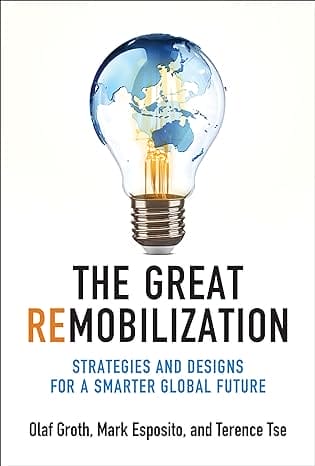
The Great Remobilization: Strategies and Designs for a Smarter Global Future
(The MIT Press, October 2023)
Praise for "The Great Remobilization"

“'The Great Remobilization' provides an essential framework for mastering the deeply systemic and structural transformations occurring in global society and for reestablishing trust in our future.”
“In an age of increasing complexity, it’s refreshing to have a compelling and well-thought-out heuristic to anchor your approach to an ever-changing world. This book is that tool.”
“The future can seem unknowable, hopelessly uncertain, and complex. 'The Great Remobilization' cuts through the confusion to make sense of the trends, phenomena, and powers shaping all of our futures. It is practical, insightful, and positive. It is what the future looks like.”
“'The Great Remobilization' sets out a treasure trove of inspirational ideas and concepts providing tools for future leaders who can cultivate new pathways for building prosperous ground to a more sustainable and innovative future for our globe.”
“'The Great Remobilization' takes on all of the massive forces upending our world today—from COVID to climate change and geopolitical tensions—and presents an easy-to-grasp framework for analyzing those forces and identifying global solutions.”
“Well-articulated moral paean and call to action on much-needed re-creation of global de-risking systems and governance structures that have not keep pace with technological change. Looking far beyond current geopolitical memes, stresses criticality of China as tectonic force that must be part of any solution.”
“The world is moving in many contradictory directions at once, making it harder than ever to divine the future. This unique compendium is an essential blend of analysis and prescription, both embracing complexity and coaching us on how to navigate it. Essential reading for leaders of today and tomorrow!”
“The last major shift in the world order followed the destruction of World War II. We are now faced with the task of building for Globalization 2.0. This book does an excellent job of highlighting the process we must employ to build a more resilient globalization with a cognitive economy.”
“We can all sense we are living a world of flux, a liminal moment, between an old state of things and the new. Many have sought to understand the sudden volatility of the systems that compose our lives by looking at the systems of energy, food, finance, society, and, of course, the environment. But Groth, Esposito, and Tse elevate our understanding to the next level. They point out the growing interconnections of each of these systems and thereby offer humanity a framework to create a new system of systems with the potential to establish a world that works for humanity and Earth.”
“This book is ambitious in scope and panoramic in coverage. The authors have crafted a robust framework for governmental and enterprise decisions (and actions) for today’s discombobulated world order. They have a command over the issues facing society and a knack for weaving anecdotes and deep insights from experts as they outline their novel approach.”
“Groth, Esposito, and Tse shine a light on a new set of converging crises, from new forms of colonization driven by multiple powerful forces to extreme inequalities, digital risks, and a planet in peril due to the effects of irreversible climate change. But they go beyond a mere recitation of problems; they also provide a framework that leaders across all sectors can use to analyze the impact of these crises, ensuring that no crisis goes to waste. The goals are lofty: renewed international relations and resilient societies based on equity, sustainability, peace, and prosperity. A tall order, but the book delivers—brilliantly.”
“It is hard to argue against the benefits of the globalization model we have seen in the past thirty years, but it’s due for a major revision. The FLP-IT model proposed in this book challenges the current global framework, effectively articulating the shifting baselines and the assumptions that shaped the current global order. Most importantly, it provides a framework to develop a new playbook that considers the central roles of technology, climate change, and China. The authors leave you with no shortage of creative ideas for new strategies, programs, and institutions to shape Globalization 2.0 in the most sustainable, equitable, and antifragile ways.”