Videos
-
 2026 Harvard Entrepreneurship Summit: Jonathan Zittrain Interviews Polymarket's Shayne Coplan
 -
Jonathan Zittrain: AI Agents and Trust
-
Jonathan Zittrain | Chautauqua Lecture Series
-
Harvard Law School Rappaport Forum: TikTok and Free Speech
-
Panel Discussion: How Can We Protect Civic Discourse in the Age of Fracture?
-
Jonathan Zittrain | The Internet is Rotting
-
Zittrain and Zuckerberg discuss encryption, ‘information fiduciaries’ and targeted advertisements
-
Automation and Algorithms in the Digital Age | Jonathan Zittrain





Learn More About Jonathan Zittrain
Still a teenager, Jonathan Zittrain almost became a full-time AI researcher in the 1980s – and then came to believe that problems among and involving people were actually tougher. He’s followed what technology is doing to us, and how we might ourselves shape it, ever since. Today he holds three professorships at Harvard, where he co-founded its Berkman Klein Center for Internet & Society.
Hailed as a top-tier speaker and advisor, Zittrain’s charismatic, informative, and thoughtful style engages audiences of all levels, bridging knowledge gaps with wit, and sidestepping simplistic predictions and frameworks. By cultivating a sense of empowerment, he reassures attendees they need not feel abandoned or left behind, promoting an environment where making complex digital decisions becomes less overwhelming.
Zittrain is not easy to pigeonhole. He is a constitutionalist, a computer scientist, and a policy expert, and clarifies such things as the construction and operation of AI models and the intricate risks posed by engaging them. As a guiding light for organizations venturing into the AI domain, he provides a sobering analysis to assist leaders and institutions in strategy formation and implementation. Nearly fifteen years ago, he wrote the field-shaking “The Future of the Internet – And How to Stop It,” predicting many of the digital issues we confront today. He is working on its sequel, “Well, We Tried.”
How to Stay Safe on the New AI Frontier
Zittrain’s research significantly focuses on understanding the unprecedented fast-paced development and deployment of AI. He uses metaphors and cultural references to make the complex training methods of these models and their eccentric outputs accessible and clear to listeners. He considers what will happen next from a “bottomless wellspring of sustained, companionable conversation” – and helps forge practical strategies for mitigating the many issues and uncertainties.
“The more you know about how something is built, the more you can recognize when it doesn’t make sense,” he observes.
Zittrain adeptly reveals why these AI models, designed to provide coherent answers over factual ones, frequently deliver “hallucinations” and deceptive narratives, and scrutinizes the prospect that these issues can be ameliorated. Zittrain soberly considers AI’s potential hazards – from misinformation and bias reinforcement to job displacement, intellectual property disputes and even existential threats. Zittrain remains an active voice in this dialogue.
With its capacity to transform all business sectors, the implications of AI cannot be disregarded. Zittrain’s insights clarify AI’s complex mechanisms and highlight its potential benefits and risks, enabling leaders to harness the AI revolution to their advantage. Under his guidance, organizations do more than merely brace for AI’s next wave – they actively shape their own future within it.
Jonathan Zittrain is the George Bemis Professor of International Law at Harvard Law School. He is also a professor of public policy at the Harvard Kennedy School of Government, a professor of computer science at the Harvard School of Engineering and Applied Sciences, director of the Harvard Law School Library, and co-founder and director of Harvard’s Berkman Klein Center for Internet & Society.
His research interests include the ethics and governance of artificial intelligence; battles for control of digital property; the regulation of cryptography; new privacy frameworks for loyalty to users of online services; the roles of intermediaries within Internet architecture; and the useful and unobtrusive deployment of technology in education.
Zittrain established the Assembly Program, a three-track fellowship program that convenes cohorts of experts, professionals, and students to develop solutions to complex technology policy issues, including those in cybersecurity, AI and online disinformation. He also championed the development of the Caselaw Access Project, which has expanded free public access to U.S. case law.
Zittrain is a member of the American Academy of Arts and Sciences and the Board of Directors of the Electronic Frontier Foundation. He has served on the Board of Advisors for Scientific American, as a Trustee of the Internet Society, and as a Forum Fellow of the World Economic Forum, which named him a Young Global Leader. He was the Distinguished Scholar-in-Residence at the Federal Communications Commission, where he chaired the Open Internet Advisory Committee. His book, “The Future of the Internet – And How to Stop It,” predicted the end of general purpose client computing and the corresponding rise of new gatekeepers.
Jonathan Zittrain is available to advise your organization via virtual and in-person consulting meetings, interactive workshops and customized keynotes through the exclusive representation of Stern Speakers & Advisors, a division of Stern Strategy Group®.
The Map and a Compass, Not the Playbook
Most conferences can find you an AI expert who might give you a checklist of what to do about artificial intelligence. Jonathan Zittrain is something rarer: a thinker who will help you understand how to think about AI both now and for whatever comes next – especially important for a phenomenon that no one can reliably predict.
Drawing on 30 years of pioneering practice and theory at the intersection of technology, law, and society, Zittrain arrives not with a consultant’s playbook but with a map and a
compass. He’s the trusted guide who can walk a room of executives, policymakers, or everyday people through the genuine complexity of this moment and engage on how it bears specifically on the people in the room, with wit, precision, and an uncanny ability to make the abstract become urgent and clear.
Whether unpacking his “AI triad” (the accelerationists, the safety advocates, and the skeptics and why all three are worth understanding), exploring the frontier of AI agents
roaming the internet with no one minding the leash, or tracing what a 25-year-old predictive system in a hospital tells us about who gets to decide life-and-death questions, Zittrain brings perspectives that audiences haven’t encountered elsewhere and frames it in ways they won’t soon forget.
He’s equally at home delivering a keynote, joining a fireside chat, or moderating a deep and entrancing conversation among big personalities. The throughline is always the same: you’ll leave not just informed, but genuinely better equipped to evaluate whatever technology throws at you next.















Don't Panic: Making Progress on the "Going Dark" Debate
(The Berkman Center for Internet & Society at Harvard University, February 2016)

Access Contested: Security, Identity, and Resistance in Asian Cyberspace (Information Revolution and Global Politics)
(The MIT Press, September 2011)

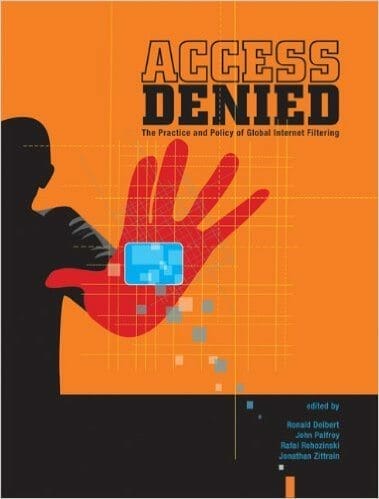
Access Denied: The Practice and Policy of Global Internet Filtering (Information Revolution and Global Politics)
(The MIT Press, January 2008)
“Jonathan was superb. We have never had such a high quality series of executives sharing meaningful insights together in one room like that before in our 9+ year history of doing this. Definitely a format we intend to replicate in other events going forward.”
“These days, it’s hard to be surprised/amazed about new technologies or disruptions that might come true in the near future, but Jonathan’s speech gave me a whole perspective about things I wasn’t even aware of. It’s not only what he says – which is amazing and truly interesting, it’s how he communicates.”
“The highlight was hearing a keynote from Jonathan Zittrain on 'The Future of the Internet and How to Stop It.' He was so entertaining and informative. If you ever have a chance to hear him, take it. We shouldn’t believe that the Net will always be what we have now, plus more. Between aggressive government regulators, technology 'advances,' cautious administrators and political pressure groups, we could end up with less, not more, in the future.”
Awarded Young Global Leader of Tomorrow
“Excellent topic – Professor Zittrain was outstanding – and a relevant topic we should keep on our agenda.”
“Jonathan Zittrain is the ultimate law-tech-policy triple-threat. He teaches internet law at Harvard Law School and at the Kennedy School, is professor of computer science at the Harvard School of Engineering and Applied Sciences, and faculty co-director of Harvard’s Berkman Center for Internet & Society. He’s done interesting work on the possibilities and implications of crowdsourcing, and wrote a cautionary tale about risks of internet capture and lockdown called 'The Future of the Internet–and How to Stop It.' Technology advances quickly, and so do the legal frameworks we use to understand it. But Jonathan seems to be living in the future and explaining it to us in the present. Which is cool.”